Eosinophilic Gastrointestinal Diseases (EGIDs) are a group of rare, chronic disorders characterized by inflammation predominantly driven by eosinophils, triggered by an immune-mediated response (or an allergen-mediated response) affecting the lining of specific segments of the digestive tract. The most common subtype is Eosinophilic Esophagitis (EoE).
Symptoms are related to dysfunction of the affected part of the gastrointestinal tract and can have a major impact on the patient’s quality of life, starting from childhood. This is due both to the frequent delay in diagnosis, linked to the non-specific nature of symptoms and the rarity of these conditions, and to the lack of a definitive curative treatment.
When an eosinophilic gastrointestinal disease is associated with a neurodevelopmental disorder, the diagnostic pathway for EGIDs becomes even more challenging. Communication difficulties and the increased occurrence of feeding disorders in this population from early childhood—both factors that can complicate the diagnostic process—make dedicated support essential for patients with this comorbidity.
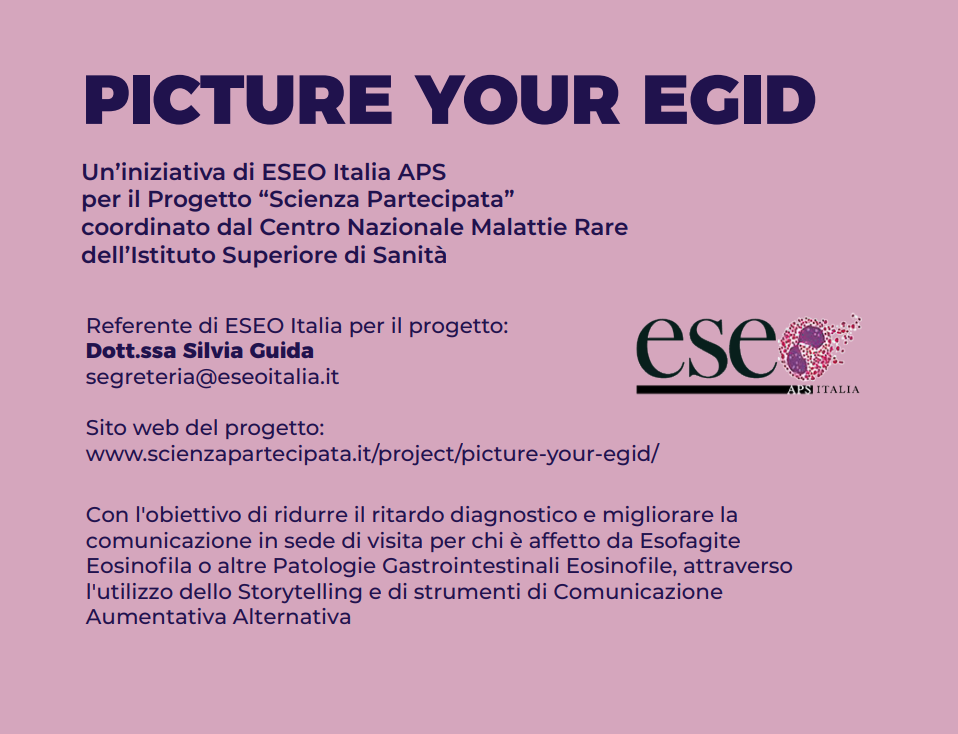
The objectives of the “Picture Your EGIDs” project are as follows:
To raise awareness among people living with neurodevelopmental disorders (ND) and within healthcare settings dedicated to ND and gastrointestinal diseases about the EGIDs+ND comorbidity.
To support people with ND throughout the EGID care pathway, from diagnosis to follow-up, by enabling them to share their own experience and by improving direct communication between the patient and the treating clinician during medical visits.
To equip healthcare professionals with useful tools to strengthen the therapeutic relationship with patients and caregivers living with the EGIDs+ND comorbidity.
Phase 1: collection, starting from ESEO members, of care stories from patients and caregivers affected by EGIDs, as well as from patients with EGIDs+ND comorbidity, using a narrative medicine approach.
Phase 2: digitization of the collected material into a database that will be made available to the patient/caregiver and to the healthcare professional authorized by the patient, both on hardware support (USB drive) and online through a secure server.
Phase 3: identification of the most distinctive features emerging from the care stories of patients with EGIDs+ND comorbidity, compared with the EGIDs population without neurodevelopmental disorders.
Phase 4: translation of the care stories and of the main diagnostic and therapeutic procedures, as indicated by ESEO’s scientific and technical committee, into one or more accessible communication formats already in use or proposed for patients with ND (AAC, easy-to-read language, etc.), through the use of existing paper-based or digital tools, or tools further developed in collaboration with an illustrator.
Phase 5: creation of a digital kit in accessible language, continuously updated and made available both to users and to designated care settings, in order to facilitate both the communication of the patient’s/caregiver’s history to the treating clinician and the communication of diagnostic and therapeutic information from the clinician to the patient/caregiver. In other words, a tool that can be used by both parties to communicate more effectively and directly.
The subsequent phases require institutional support external to ESEO:
A study, in collaboration with hospital-based or community healthcare centers, aimed at developing and validating an ad hoc questionnaire, including in accessible language, that healthcare professionals can use with patients with EGIDs+ND comorbidity.
Devices (mobile phones, tablets, etc.) to be made available to patients/caregivers and care centers, containing the care stories database, the digital kit in accessible language, and the validated questionnaire.
All activities, including professional activities, carried out by the association’s members and by physicians for the development and management of the projects are performed on a voluntary basis and without compensation.